Money Matters
AI's thirst for electricity: the three bills making data centers pay for the grid have passed — Newsom's signature is next
On the session's final night — August 31, 2026 — California lawmakers passed all three bills requiring data centers to pay their own share of grid costs. The final word now belongs to Governor Newsom by September 30, 2026, and your electric bill is part of what's riding on it.
- All three bills — SB 1168, SB 886, and AB 2383 — passed the California Legislature on the night of August 31, 2026. They make data centers pay the grid costs they create, instead of spreading those costs across every electricity customer.
- Southern California Edison — the utility serving our area — is on the opposing side, along with Amazon, Google, Meta, PG&E and others, according to CalMatters. The companies have spent hundreds of thousands of dollars lobbying.
- All three now sit on Governor Newsom's desk — his deadline to sign or veto: September 30, 2026. Final Senate votes: SB 1168 passed 38–0, SB 886 28–10, and AB 2383 28–9.
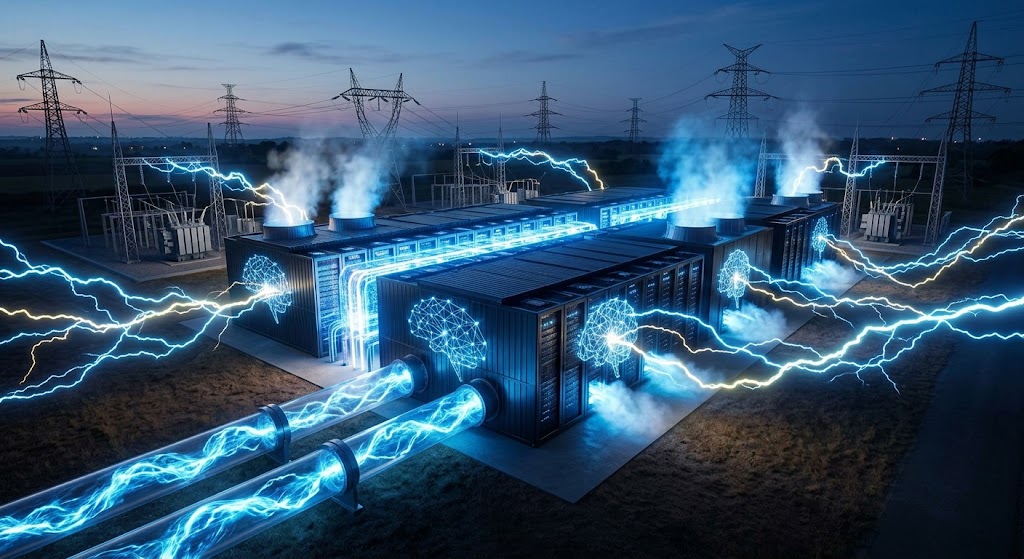
SACRAMENTO — California is in a data center building boom, driven by the AI rush. A data center is a giant warehouse full of servers: every time you ask a chatbot a question, stream a video, or send money through an app, servers in one of these buildings do the work. And they consume enormous amounts of electricity. SB 1168 cites a forecast from the ISO, the state's grid operator: data center demand will grow by 2.3 gigawatts by 2030. A gigawatt is a unit of power so large it usually only comes up when talking about the entire grid.
Serving that demand means new lines, new substations, grid upgrades. Under today's rules, those costs are spread across all electricity customers — meaning households and small shops help carry the infrastructure that data centers require. Three bills in Sacramento were written to change that split. On the session's final night — August 31, 2026 — all three passed. The only signature left to collect is the Governor's.
How the three bills would change the rules
All three aim at the same spot: how the money for building and upgrading the grid gets divided.
- SB 1168 (Sen. Jerry McNerney): directs the CPUC — the California Public Utilities Commission, which sets electricity rates — to develop rate structures ensuring data centers pay their reasonable share of transmission and distribution costs, plus the clean energy procurement they drive. The bill states its goal plainly: easing rate pressure on residential customers, including low-income households.
- SB 886 (Sens. Steve Padilla and McNerney): by January 1, 2028, the CPUC must establish separate tariffs for new large-load customers such as data centers. The threshold is set by the CPUC but cannot exceed 25 megawatts of peak demand. If a facility's hookup triggers line upgrades, the facility pays for them in full. It also requires 10-year minimum prefunded contracts, with early-exit fees. (The final version moved the deadline from July 1, 2027 to January 1, 2028 in an August 28 amendment.)
- AB 2383 (Asm. Rick Chavez Zbur): makes data centers their own customer class with their own tariff by January 1, 2028. Their incremental costs can't be shifted onto other customer groups, and they must carry a share of wildfire-mitigation costs like other large customers. Its threshold likewise can't exceed 25 megawatts. It applies to new transmission-level interconnection contracts signed on or after January 1, 2027.
The bills' limits deserve saying out loud: they block new costs from landing on residents — they don't automatically cut the bill you have today. There's also no official estimate yet of how much any single bill would change.
Who's for, who's against — and where the lobbying money went
A fight over dividing money never stays on paper — it brings a lobbying campaign with it. According to CalMatters, the opposition includes Amazon, Google, Microsoft, Meta, OpenAI, and Anthropic, joined by two utilities — PG&E and Southern California Edison — the IBEW electrical workers' union, and the California Chamber of Commerce. Full transparency: Anthropic makes Claude, the AI tool Bolsa Bridge uses in its newsroom.
Also per CalMatters: PG&E spent $2.86 million on lobbying in the second quarter of 2026 — its second-highest quarter since 1999 — including about $143,000 on data center issues specifically. Amazon spent more than $500,000 in the first half of 2026, spread across 33 bills. Anthropic spent about $90,000 — its first year hiring lobbyists in Sacramento. The Silicon Valley Leadership Group topped $100,000, its highest annual spend since records began in 2005. The Data Center Coalition spent about $60,000.
On the supporting side: the bills' authors, community groups, and TURN — The Utility Reform Network, a longtime ratepayer advocate. "The level of concern and sensitivity is through the roof — it's bipartisan," Sen. Padilla told CalMatters. Assemblymember Diane Papan, who authored two other data center bills, told the outlet this year's environment is entirely different from last year's.
What does this have to do with the Bolsa area?
Southern California Edison is the utility that serves Westminster, Garden Grove, and Fountain Valley. All three bills apply to the state's large investor-owned utilities — SCE included. For nail salons, restaurants, and markets — where the AC, dryers, and freezers run all day — electricity is a major monthly expense. Households just paid for a summer of air conditioning too. How grid costs get divided isn't a far-off Sacramento story. It's inside the SCE envelope that arrives every month.
Who decides what happens next?
The three electricity bills belong to a group of seven data center bills CalMatters tracked this session. Three others would require disclosure of water use — two of them cleared the Legislature on Thursday, August 27, 2026. One more would require environmental review for every data center project.
In 2025, four bills to rein in data centers died or were watered down after lobbying, according to CalMatters. Only one became law — requiring state energy regulators to publish a study of the environmental impact of data centers' electricity demand. This year the Legislature went the other way: all three electricity bills cleared on the final night, August 31. Now the final call belongs to Governor Newsom, with a September 30, 2026 deadline. And the question of who carries the costs of the AI era will follow Californians through many billing cycles to come.
WANT TO FOLLOW ALONG — OR WEIGH IN?
Read the full text of the bills at leginfo.legislature.ca.gov — search "SB 1168," "SB 886," or "AB 2383."
Look up your state representatives by home address: findyourrep.legislature.ca.gov.
Send the Governor your view before September 30: www.gov.ca.gov/contact.
hóa đơn điện → electric bill
Hóa đơn điện mùa hè là gánh nặng của nhiều gia đình. (Summer electric bills weigh on many families.)
lưới điện → power grid
Ai trả tiền nâng cấp lưới điện? (Who pays to upgrade the power grid?)
dự luật → bill (legislation)
Cả ba dự luật đã qua nghị viện đêm 31 tháng 8. (All three bills passed the Legislature on the night of August 31.)
vận động hành lang → lobbying
Các hãng lớn chi đậm cho vận động hành lang. (The big companies spent heavily on lobbying.)
hãng điện → utility, power company
SCE là hãng điện của khu Bolsa. (SCE is the Bolsa area's utility.)
phủ quyết → to veto
Thống đốc có quyền ký hoặc phủ quyết. (The Governor can sign or veto.)
túi tiền → wallet, pocketbook (figurative)
Chuyện này chạm thẳng túi tiền độc giả. (This hits readers right in the wallet.)
🧩 Play Cầu Chữ — the daily word game from Bolsa Bridge, built from vocabulary boxes like this one →
This article is for general information only and is not financial, tax, investment, or legal advice. Please consult a licensed professional before making decisions.
Sources & verification notes · 5 sources
- CalMatters — "Big Tech is lobbying against a California data center backlash" (Katherine Ortiz & Khari Johnson, August 28, 2026): source for the lobbying figures, the lineup of opponents and supporters, and the vote timeline. Sen. Padilla's quote appears verbatim in this English version. https://calmatters.org/economy/technology/2026/08/california-data-center-backlash-big-tech-lobbying/
- SB 1168 — Data centers: rate structures (leginfo.legislature.ca.gov): bill text, read in full on August 28, 2026; source for the ISO's 2.3-gigawatt forecast. Status and vote (Senate concurrence 38–0 on August 30, 2026) re-checked September 3, 2026. https://leginfo.legislature.ca.gov/faces/billTextClient.xhtml?bill_id=202520260SB1168
- SB 886 — California Technology Innovation and Ratepayer Protection Act (leginfo.legislature.ca.gov): bill text, read in full on August 28, 2026; final version amended August 28, 2026 (tariff deadline moved to January 1, 2028; threshold capped at 25 MW); status and vote (28–10 on August 31, 2026) re-checked September 3, 2026. https://leginfo.legislature.ca.gov/faces/billTextClient.xhtml?bill_id=202520260SB886
- AB 2383 — Electricity: data centers (leginfo.legislature.ca.gov): bill text, read in full on August 28, 2026; final version amended August 28, 2026; status and Senate vote (28–9 on August 31, 2026) re-checked September 3, 2026. https://leginfo.legislature.ca.gov/faces/billTextClient.xhtml?bill_id=202520260AB2383
- Update note: written before the August 31, 2026 vote and updated on September 3, 2026 with the results. All three bills passed the Legislature and now await the Governor's signature or veto by September 30, 2026 (source: leginfo.legislature.ca.gov, checked September 3, 2026). No official estimate exists yet for per-bill impact; this story offers no guesses. The how-to links (leginfo, findyourrep, the Governor's contact page) were verified working on August 28, 2026.