Small Business
Selling Food Made at Home? Not Every Dish Qualifies as Cottage Food
California lets residents sell certain foods made in their home kitchens under the Cottage Food program, but only items on a state list. In Orange County, sellers must register or get a permit from the county’s Environmental Health division before selling.
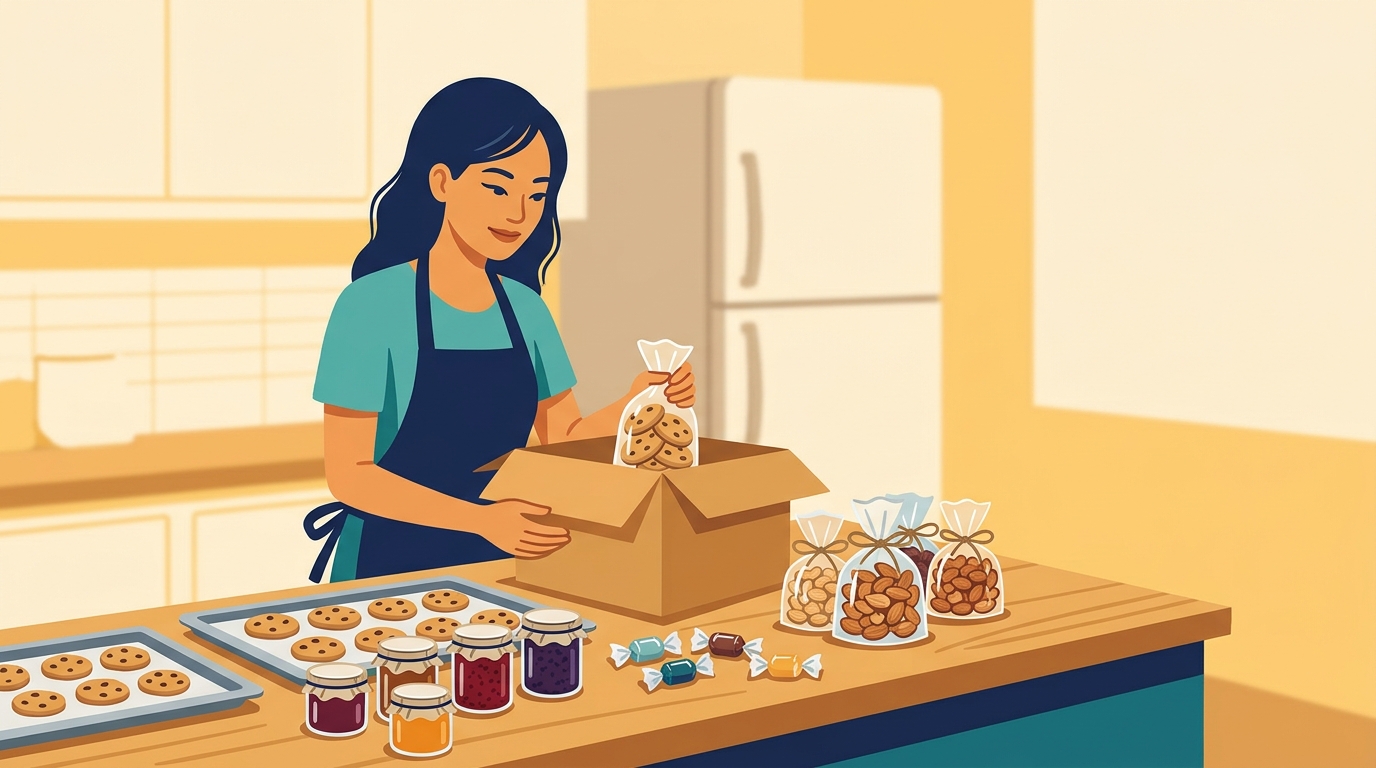
- Only foods on the state list can be sold. They must be shelf-stable and need no refrigeration, such as cookies, candy, jams and roasted nuts.
- Class A sells directly to customers; Class B can also sell through other businesses. Class A is a registration without routine inspections; Class B is a permit with an annual inspection.
- In Orange County, contact Environmental Health before taking orders. According to the county’s application packet, the initial review fee is $225 for both classes.
What does the program allow?
Cottage Food is a California program that lets people make certain foods in their own home kitchens and sell them. According to the California Department of Public Health (CDPH), only foods that are not potentially hazardous qualify.
CDPH maintains the list of approved foods but does not issue permits or registrations. That is handled by each county’s Environmental Health agency. In Orange County, it is Environmental Health at the OC Health Care Agency.
According to Orange County Environmental Health, foods must meet two conditions: they must be on the state list, and they must be shelf-stable without refrigeration.
What is on the list?
According to the CDPH list updated in October 2026, there are 10 approved categories:
- Baked goods without cream, custard or meat fillings, such as breads, cookies and fruit-only pies.
- Candy and confections.
- Extracts of 70 proof or higher.
- Dried, dehydrated or freeze-dried foods, such as roasted coffee, dried tea and granola.
- Frostings without eggs, cream or cream cheese.
- Pure honey and sorghum syrup.
- Fruit butters, jams and jellies meeting federal standards.
- Roasted nuts and nut butters.
- Powdered drink mixes.
- Vinegars and mustards.
Pumpkin pie is not on the list. Foods that need refrigeration or contain meat or cream fillings also do not qualify. If you are unsure where your product fits, ask the agency before designing a label.
How do Class A and Class B differ?
According to CDPH, Class A operations may sell only directly to consumers. Orders can be taken by phone or online, and food can be handed over in person, mailed or sent through a delivery service.
Class B operations may sell directly and indirectly. Indirect sales mean selling to restaurants, markets or coffee shops that resell the food to their customers.
In Orange County, Class A is a registration with no routine inspection. Class B is a permit with an annual inspection, and a Class B holder may also sell as Class A. Both classes may sell only within California.
Sales limits
The law sets base limits of $75,000 in gross annual sales for Class A and $150,000 for Class B, adjusted each year for inflation.
According to CDPH’s adjustment table, the limits in effect since Jan. 1, 2026, are $88,878 for Class A and $177,756 for Class B. Some CDPH and county pages still show the base amounts. Sellers close to the limit should ask Environmental Health which figure applies.
Key rules in Orange County
According to the Cottage Food page and application packet from Orange County Environmental Health:
- Fees: the initial review fee is $225 for Class A or B and covers up to 10 labels plus the first-year permit. Under the county’s 2025–2026 fee schedule, annual renewal is $128 for Class A and $384 for Class B. Fees are non-refundable.
- Where food is made: only in the kitchen of the home where the operator lives and an attached storage room. A registration or permit covers only that person and that address.
- Staff: no more than one full-time-equivalent employee, not counting family or household members.
- Food safety training: operators and staff must complete a food processor course within 90 days of registration or permitting and repeat it every three years.
- Labels: must state “Made in a Home Kitchen” and meet state and federal food labeling rules. All labels must be approved before sale.
- Farmers’ markets and fairs: selling in person at these events requires a separate temporary food facility (TFF) permit.
Orange County Environmental Health:
(714) 433-6000 · EHCottageFood@ochca.com
1241 E. Dyer Road, Suite 120, Santa Ana, CA 92705
Monday–Friday, 8 a.m. to 4 p.m.
Fees and procedures may change with the county’s fiscal year. Check the current fee schedule on the county website before applying. Questions about taxes or city business licenses should go to a licensed professional.
Translation assisted by AI and reviewed by an editor.
bếp nhà → home kitchen
Món phải làm trong bếp nhà nơi mình ở.
đồ ăn làm tại nhà → homemade food
Không phải đồ ăn làm tại nhà nào cũng được bán.
giấy phép → permit
Class B cần giấy phép của quận.
nhãn → label
Mọi nhãn phải được duyệt trước khi bán.
doanh thu → revenue, sales
Doanh thu mỗi năm có giới hạn.
tủ lạnh → refrigerator
Món cần tủ lạnh không thuộc diện này.
lệ phí → fee
Lệ phí xét đơn lần đầu là $225.
🧩 Play Cầu Chữ — the daily word game from Bolsa Bridge, built from vocabulary boxes like this one →
This article is for general information only and is not financial, tax, investment, or legal advice. Please consult a licensed professional before making decisions.
Sources & verification notes · 5 sources
- CDPH — Cottage Food Operations — https://www.cdph.ca.gov/Programs/CEH/DFDCS/Pages/FDBPrograms/FoodSafetyProgram/CottageFoodOperations.aspx. English-language CDPH page; CDPH does not issue permits, and the page defines Class A and B, training, labeling and sales limits. The main page still shows the $75,000/$150,000 base amounts. Checked Oct. 29, 2026.
- CDPH — Approved Cottage Foods List (PDF) — https://www.cdph.ca.gov/Programs/CEH/DFDCS/CDPH%20Document%20Library/FDB/FoodSafetyProgram/CottageFood/ApprovedCottageFoodsList.pdf. English-language list marked updated October 2026, with 10 categories and the pumpkin pie exclusion.
- CDPH — Cottage Food Operation Adjusted Gross Annual Sales Limit 2026 (PDF) — https://www.cdph.ca.gov/Programs/CEH/DFDCS/CDPH%20Document%20Library/FDB/FoodSafetyProgram/CottageFood/CFOAdjustedGrossAnnualSalesLimit2026.pdf. English-language table; CPI-adjusted limits effective Jan. 1, 2026, are $88,878 (A) and $177,756 (B).
- OC Health Care Agency — Cottage Food — https://www.ochealthinfo.com/services-programs/environmental-health/food-safety-programs/cottage-food. English-language Orange County Environmental Health page with food requirements, Class A/B, the July 2025–June 2026 fee schedule, address and how to apply.
- OC Health Care Agency — Cottage Food Operation Packet (PDF) — https://www.ochealthinfo.com/sites/healthcare/files/2026-09/Cottage_Food_Operation_Packet_09.01.2026_0.pdf. English-language application packet with pages dated Aug. 17, 2026, covering the $225 review fee, the 90-day course, the one-employee limit, labels and TFF permits.