Small Business
Your shop's phone is ringing and every hand is busy? AI can answer — if you know the law and its limits
"AI phone answering" services are pitching hard to restaurants, nail salons, and small offices, at a few dozen to a few hundred dollars a month. Before your shop hands its customers' calls to a machine: where it beats a human and where it doesn't, what California law demands, and six questions to ask before you sign.
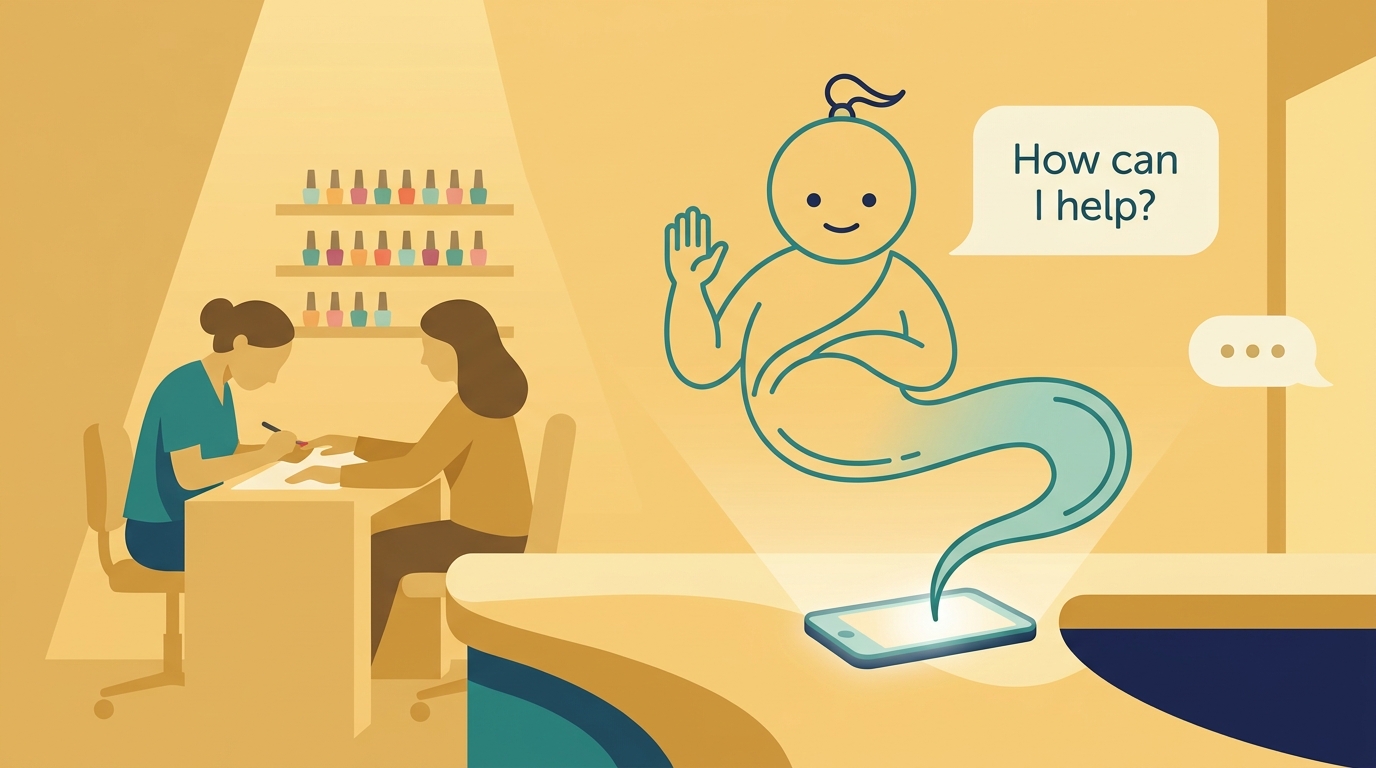
- An AI receptionist can catch calls when every hand in the shop is busy: it gives your hours, books appointments, texts customers back. Typical plans run from about $29 to $450 a month.
- California law requires every party's consent before a call is recorded — and 2025 lawsuits extend that fight to machines that listen and transcribe in real time. The agent must open with two things: it's a virtual assistant, and the call may be recorded — violations can draw lawsuits of $5,000 per call.
- Before signing: call it yourself, in Vietnamese, in your family's own voice. Insist on "press 0 for a real person." Pin down whether you pay by month, by minute, or by call.
What's happening
Two o'clock on a Saturday, every chair in the nail salon full. The phone rings, and every technician's hands are on a client. That call is usually an appointment — and the caller won't wait. Nobody picks up, and the customer dials the next salon on Google.
Lunch rush at a restaurant is the same story: the person answering the phone is also running tables and the register.
A new kind of service aims squarely at that gap: the AI receptionist, also sold as an AI answering service. It isn't voicemail. It talks with your customer like a front-desk employee, around the clock. Plans for small shops start at a few dozen dollars a month.
How is it different from voicemail?
Before the money question, know what the machine can actually do.
Voicemail just takes messages. Phone menus make callers sit through a list of options. An AI agent talks back, close to the way a person does. A few things it can handle:
- A customer asks "what time do you close?" — it answers on the spot, even at midnight.
- A customer wants three o'clock Friday — it checks the calendar, takes a name and number.
- A question gets complicated — it transfers the call to a human, or offers a callback.
But it is a machine: it can say the wrong thing and hear the wrong thing. We weigh that honestly right below.
Machine or human? An honest weighing
The AI industry is promising big. Sam Altman — CEO of OpenAI, the company behind ChatGPT — wrote in early 2025: "We believe that, in 2025, we may see the first AI agents 'join the workforce' and materially change the output of companies." For a small shop, that promise deserves real consideration — weighed on both sides of the scale, because a vendor's pitch only ever tells you one.
The machine beats a human in four places. It's on duty around the clock — midnight, Sundays, Tết — and it's never "hands full," because it can take several calls at once. It's consistent: the hundredth "what are your hours?" gets the same patient answer as the first. It writes every call down for the owner to read later. And it's cheap compared to human labor: by comparison-site figures, per-minute rates for live human answering services run several times an AI's — and hiring a full-time employee just to answer phones is beyond most small shops.
But a human beats the machine exactly where your shop lives. A person can follow a difficult accent, a meandering story, the Vietnamese-mixed-with-English of an older customer — a machine may not, which is why the "call it in your own voice" test sits in the vendor section below. A person can carry the calls that have feelings in them — an angry customer, a complaint, a negotiation — where one genuinely sympathetic sentence is worth more than any script. A person knows the shop: who's out today, which chair a regular likes. And for more than a few older customers in our community, a familiar voice picking up IS part of the shop — hearing a robot, some will simply hang up. Losing one lunchtime call stings; cooling off a ten-year regular costs far more.
And count the machine's downsides in full — don't let the pitch hide them. The machine can be wrong without knowing it's wrong — quoting a bad price, double-booking a slot — and to your customer, that's your shop's mistake, not the vendor's. How big that risk is depends on how the agent is built. A good agent is grounded in the truth your own shop provides — grounding means it answers only from the price list, the calendar, and the hours you feed it; when a question falls outside that, it says so plainly and hands the call to a human instead of guessing to keep the conversation smooth. A sloppy agent does the opposite: it makes things up, fluently. Recording and transcribing carry real legal risk (next section). And you become dependent on the vendor: if they stumble or fold, your phone line stumbles with them.
Stanford economist Erik Brynjolfsson, who has studied AI and work for decades, points to the right frame: build machines that help people rather than play people. He writes: "When AI is focused on augmenting humans rather than mimicking them, then humans retain the power to insist on a share of the value created." Applied to a shop, the right question isn't "machine or human" — it's how to split the work: the machine takes the outer layer (off hours, rush hours, the simple repeated questions); people keep the inner layer (regulars, money matters, anything delicate). "Press 0 for a real person" is the bridge between the two.
🔰 BACK TO BASICS
Three free things to do before paying for AI:
1. Fix your shop's Google profile. Google Business Profile is the card customers see when they search for you. Get the hours and phone number right — many "what time do you open?" calls simply disappear.
2. Pick one human to receive transferred calls. However good the machine, there must be an exit to a person. Decide now who carries that phone.
3. Write down the five questions customers ask most, with your answers. That sheet is the first lesson you teach the machine. Without it, the machine answers its own way.
The "Your Shop Online" series will cover each of these basics in its own story.
Law first, money second: recording requires permission
The machine listens to and logs your calls — and in California, that's a matter of law.
AI services typically record calls, or transcribe them for the owner to review. Under California Penal Code section 632.7, recording any call involving a cell phone requires the consent of every party — criminal fines run up to $2,500 per violation. Under section 637.2, a person recorded without consent can also sue: $5,000 per call, no proof of damages required.
There's also a newer layer of risk, now in front of the courts. Many services say they "don't record" — but the machine still listens and transcribes while the customer talks. California lawsuits filed in 2025 aim exactly there: the AI vendor in the middle stands accused of being a third-party eavesdropper under section 631, even without saving an audio file. One AI company that answers phones for pizza restaurants has been sued on this theory; a federal court has also allowed a similar case against Google to proceed. In short: "no recording" does not mean "no legal exposure."
What does this mean for your shop? The opening greeting should carry both parts — the machine identifies itself as a virtual assistant, and announces the call may be recorded. Something like: "This is the shop's virtual assistant. This call may be recorded." Saying "I'm an AI" alone isn't enough — that's identity disclosure, not consent to record and transcribe. Have the vendor switch that two-part greeting on, in both languages. For your shop's specific situation, ask a lawyer — a news story is not legal advice.
The freshest lesson landed this month. On August 27, 2026, the FTC — the Federal Trade Commission, the government's consumer-protection agency — finalized a $930,000 settlement with three companies charged over selling advertisers an "AI eavesdropping" service. Per the FTC, the service wasn't based on voice data at all — and collecting people's voice without adequate consent violates the FTC Act. Bolsa Bridge [covered that case in its own story](/bai/dien-thoai-nghe-len).
The letters "AI" don't make a vendor trustworthy
Law sorted — now choosing a vendor, in a very noisy market.
Since 2024, the FTC has run Operation AI Comply, a crackdown on inflated claims that wear the AI label. Then-FTC Chair Lina Khan put it in one sentence worth taping to the counter: "The FTC's enforcement actions make clear that there is no AI exemption from the laws on the books." Every vendor calls itself "smart" and claims it "understands every language"; a pitch is not evidence. Three filters first:
- A real company. An address, humans who answer, a contract you can exit. The AI market is crowded with brand-new startups; if the company vanishes, your phone line hangs with it.
- Public pricing. A vendor that hides prices until you call — be wary.
- Vietnamese, tested with your own ears. Some vendors advertise Vietnamese voices and comprehension; that's still self-description. How the machine handles a Southern Vietnamese accent, or sentences that switch between Vietnamese and English mid-stream, nobody can verify for you. Wharton professor Ethan Mollick, who studies how AI performs at work, describes the machine's temperament: "AI has a jagged frontier. It is good at some things that seem very hard and bad at some things that seem really easy for humans." You won't know where the frontier sits until you test it. The surest check: call it yourself in your family's own voice, and have your parents call too. When Bolsa Bridge built the audio versions of its own stories, we settled on a voice only after listening — paper doesn't tell you.
The money: three pricing models — do your own math
Past those three gates, then look at prices.
Per comparison sites (August 2026 figures), pricing comes in three shapes:
- Per minute: roughly $0.10–$0.50 per minute of machine talk.
- Per call: roughly $0.50–$1.50 each.
- Flat monthly: small plans around $29–$79; restaurant-specialized plans around $199–$450.
Prices change often — check the vendor's official page before signing. Then run the one calculation worth running: what is a kept appointment worth to your shop? How many extra appointments a month is break-even? That number is different for every shop — nobody can compute it for you.
Managing expectations: the machine will get things wrong
The weighing above said it plainly: the machine will err, and to your customer that's your shop's error. Here is how to manage that risk in the machine's first weeks:
- Give the machine simple jobs first: hours, address, routine bookings.
- Anything where a wrong answer costs money — condition-dependent pricing, customer complaints — must route to a human.
- For the first two weeks, spend ten minutes each evening reading the call transcripts. Where the machine goes wrong, fix its teaching.
- Keep "press 0 for a real person" permanently.
Six questions before you sign
Meet the salesperson with these six in hand:
1. Can it understand Vietnamese — can I call and test it right now?
2. Where do its answers come from — only the price list, calendar, and information my shop provides, or does it guess? What does it say when a question falls outside that?
3. How is billing structured: monthly, per minute, or per call? Any fees not yet mentioned?
4. Where are recordings and transcripts stored, does the company use them for anything else, and can they be deleted?
5. How much notice does canceling take, and does it cost anything?
6. When the machine answers wrong, who fixes it, and how many days does that take?
A solid vendor answers all six without stumbling. A vendor that dances around them — that's an answer too.
The machine keeps the call; people keep the customer
An AI receptionist doesn't replace the person who runs the shop. It only catches the calls that would otherwise fall on the floor. Whether it's worth the money is the owner's call after a few weeks of testing — with the recording law in hand and six questions in your pocket. In this neighborhood, customers call their shops in two languages. The shop that can answer in both — by human or by machine — is the shop that keeps them.
bận tay → hands are full / busy
Cả tiệm đang bận tay, không ai bắt máy. (Every hand in the shop is busy — nobody can pick up.)
bắt máy → to answer the phone
Không ai bắt máy, khách gọi tiệm kế tiếp. (Nobody answers, and the customer calls the next shop.)
cái hẹn → appointment
Máy ghi cái hẹn ba giờ chiều thứ Sáu. (The machine books the 3 p.m. Friday appointment.)
khách quen → regular customer
Đừng làm nguội một mối khách quen mười năm. (Don't cool off a ten-year regular.)
chủ tiệm → shop owner
Chủ tiệm tự quyết sau vài tuần thử. (The owner decides after a few weeks of testing.)
giọng miền Nam → Southern Vietnamese accent
Máy có nghe được giọng miền Nam không? (Can the machine understand a Southern accent?)
gọi thử → to make a test call
Tự gọi thử bằng chính giọng nhà mình. (Make a test call in your family's own voice.)
vụ kiện → lawsuit
Các vụ kiện năm 2025 nhắm vào hãng AI đứng giữa. (The 2025 lawsuits target the AI vendor in the middle.)
🧩 Play Cầu Chữ — the daily word game from Bolsa Bridge, built from vocabulary boxes like this one →
This article is for general information only and is not financial, tax, investment, or legal advice. Please consult a licensed professional before making decisions.
Sources & verification notes · 9 sources
- California Penal Code section 632.7 — all-party consent requirement for recording calls involving a cell phone; criminal penalties. Checked against the statute text on August 29, 2026. https://leginfo.legislature.ca.gov/faces/codes_displaySection.xhtml?lawCode=PEN§ionNum=632.7
- California Penal Code section 637.2 — civil remedy of $5,000 per violation or treble actual damages, no proof of damages required. Checked August 29, 2026. https://leginfo.legislature.ca.gov/faces/codes_displaySection.xhtml?lawCode=PEN§ionNum=637.2
- CIPA section 631 litigation over AI voice services (2025–2026) — sources for the third-party-eavesdropping section: Goodwin (Feb 2025, Ambriz v. Google), Wilson Sonsini (Sept 2025, federal court lets the class action proceed), Holland & Knight (May 2026, incl. ConverseNow — the AI that answers phones for Domino's, sued Jan 2025), Captain Compliance (Brewer v. Otter.ai, Aug 2025). Pending cases, not final judgments; the story says "accused / allowed to proceed" accordingly.
- FTC press release, August 27, 2026 — the $930,000 "Active Listening" settlement (Cox Media Group, MindSift, 1010 Digital Works). Fully verified in Bolsa Bridge's separate story on the case (linked in the article body).
- FTC — Operation AI Comply, September 25, 2024 press release: source for the crackdown on inflated AI claims and Chair Lina Khan's verbatim quote. https://www.ftc.gov/news-events/news/press-releases/2024/09/ftc-announces-crackdown-deceptive-ai-claims-schemes
- Service price ranges (August 2026 figures) — compiled from comparison sites: getvoip.com/blog/ai-answering-services · skipcalls.com · dapta.ai · kea.ai. Direct check on August 29, 2026: goodcall.com/pricing lists $79–$249/month (unlimited minutes) — within the ranges cited. Prices change often; readers should confirm on vendors' official pages before signing.
- Vendor self-description on Vietnamese support — autocalls.ai/language/vietnamese: an example of a vendor advertising Vietnamese voices and comprehension. The story flags this as self-description, not independently verified.
- Thought-leader quotes (verbatim English, checked August 29, 2026): Sam Altman, "Reflections" (blog.samaltman.com/reflections, Jan 2025) · Erik Brynjolfsson, "The Turing Trap" (arxiv.org/abs/2201.04200, 2022) · Ethan Mollick, X post on the "jagged frontier" (x.com/emollick/status/1799626582677659818; concept from "Navigating the Jagged Technological Frontier," Harvard Business School/BCG) · Lina Khan (Operation AI Comply source above). All four quotes appear verbatim in both language versions; the Vietnamese version adds an in-line gloss.
- Verification note: the recording statutes and all four quotes were checked verbatim on August 29, 2026. Vendors' Vietnamese-language claims could not be independently verified — the story turns this into the "call it in your own voice" advice. No law has been confirmed that REQUIRES AI self-identification for inbound calls to a shop — the story frames the two-part greeting as safe practice, not a legal mandate. The in-body link to the FTC story goes live once that story is published.