Safety · Scam Alert
Is your phone eavesdropping to serve you ads? The firms that sold "Active Listening" made it up, the FTC says
The FTC has finalized orders requiring Cox Media Group and two marketing firms to pay a combined $930,000 over "Active Listening" — a service they claimed used AI to capture conversations from phones and smart speakers and turn them into targeted ads. The case lands on a fear every family knows: why does an ad show up for the exact thing you just talked about?
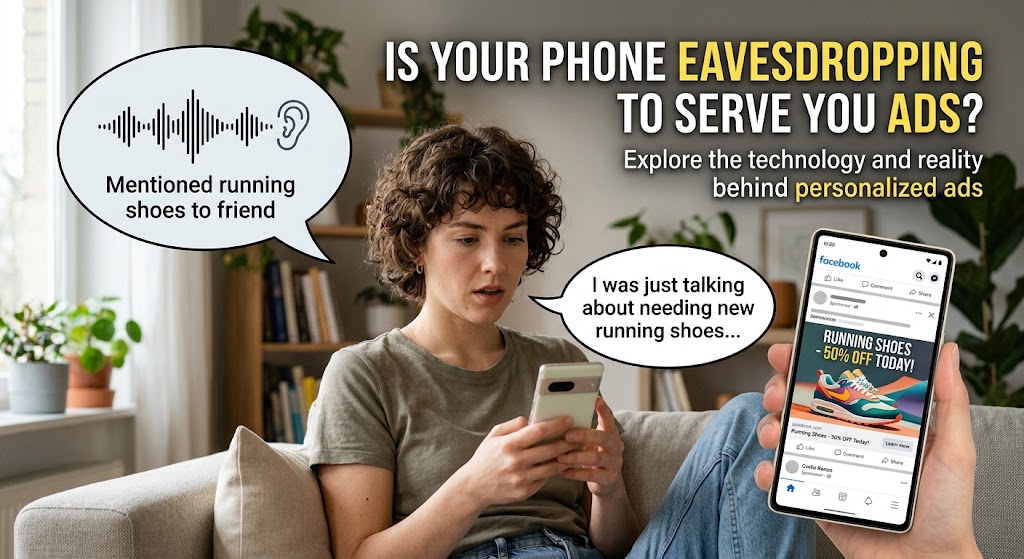
- Three companies are paying $930,000 to settle charges they deceived advertisers with a service called "Active Listening." According to the FTC, the service wasn't based on voice data at all — no AI was listening.
- The FTC added a point worth remembering: even if the service had been real, it would have been illegal. Collecting people's voice data without adequate consent violates the FTC Act.
- For peace of mind, check your phone's microphone permissions — the steps are in this story. Report deceptive ads at ReportFraud.ftc.gov; the FTC has an interpreter line with Vietnamese service.
WASHINGTON — On August 27, 2026, the Federal Trade Commission — the federal agency that protects consumers — finalized settlement orders with three companies: Georgia-based CMG Media Corporation, which does business as Cox Media Group, and two marketing firms it worked with, MindSift of New Hampshire and 1010 Digital Works of Wisconsin. The FTC first announced the complaints in May 2026.
According to the FTC, the companies told advertising clients they had a special algorithm that could listen in on conversations through smart devices in people's homes, detect who needed what, and aim ads at the right neighborhoods. They also claimed consumers had opted in to being listened to.
The FTC concluded both claims were false. The marketing service, in the press release's words, "wasn't based on voice data," and consumers had never consented. The agency added a detail worth sitting with: had the service worked as advertised, collecting and using people's voice data without adequate consent would itself have violated the FTC Act. In other words, "AI eavesdropping" was either fake or illegal — there was no legitimate version of it.
Who actually got deceived — and where you fit in
The easiest thing to get wrong about this case: the direct victims weren't people being "listened to," because no one was. The victims were the businesses that paid for the ad service. Under the orders, Cox Media Group pays $880,000 and MindSift and 1010 Digital Works pay $25,000 each, with the money going toward redress for CMG's affected customers. The Commission voted 2-0 to finalize the consent agreements after receiving two public comments on the proposed orders.
Consumers still sit at the center of the story, though. The "AI is listening" pitch sold because it traded on a real and widespread fear — the feeling that your phone is listening to you. That fear was the product these companies were selling.
Why ads seem to read your mind
If nothing is listening, why do ads feel so telepathic? The answer is the sheer amount of other data that apps and websites collect — more than most of us assume. A few familiar examples:
- You talk about plane tickets — but you searched fares online last week. The ads are following that search.
- You mention a restaurant — but location data shows you stood inside it for thirty minutes.
- Someone on your home wifi just shopped for a crib — and crib ads reach your phone too, because ad systems target whole households.
Add selective memory on top: hundreds of ads scroll past you every day. You forget nearly all of them and remember exactly the one that matched your conversation — which makes the "it's listening" feeling even stronger.
Check your own phone in two minutes
Understanding the mechanics is one thing — controlling your own microphone feels better. Three steps you can do right now:
Step 1 — iPhone: open Settings → Privacy & Security → Microphone. See an app with no business using your mic? Toggle it off.
Step 2 — Android: open Settings → Security & privacy → Permission manager → Microphone. Menu names vary a little by model.
Step 3 — watch the indicator: recent phones show a signal at the top of the screen whenever the mic or camera is on. iPhones show an orange dot for the microphone; newer Androids show a green indicator.
Turning off an app's mic permission doesn't break the app — the phone will simply ask again when the app genuinely needs it, like for a video call or a voice message.
The consumer lesson of the AI era
This settlement closes one case, but it belongs to a bigger pattern. Since 2024, the FTC has run Operation AI Comply, a crackdown on inflated claims that wear the "AI" label. The letters "AI" in a sales pitch don't make the pitch more trustworthy — whether you're a business buying services or a consumer seeing ads. And the FTC repeats its own rule of thumb for spotting impostors: the FTC will never demand money, make threats, tell you to transfer money, or promise a prize.
REPORT IT, OR READ MORE
Report fraud and deceptive advertising: ReportFraud.ftc.gov.
FTC phone lines with Vietnamese interpreters — worth sharing with your parents and grandparents. Report fraud:
(877) 382-4357, press 3 for an interpreter.
Report identity theft:
(877) 438-4338, choose your language.
Hours for both lines: 9 a.m. – 5 p.m. Eastern.
FTC resources in Vietnamese: consumer.ftc.gov/resources-vietnamese.
nghe lén → to eavesdrop
Điện thoại có nghe lén mình không? (Is my phone eavesdropping on me?)
dàn xếp → settlement
Ba công ty nộp tiền dàn xếp với FTC. (The three companies paid to settle with the FTC.)
quảng cáo → advertisement, ad
Quảng cáo bám theo lượt tìm kiếm, không phải giọng nói. (Ads follow your searches, not your voice.)
quyền dùng micro → microphone permission
Nhớ kiểm tra quyền dùng micro của từng app. (Remember to check each app's microphone permission.)
nỗi sợ → fear
Lời rao bán được là nhờ một nỗi sợ có thật. (The pitch sold because the fear is real.)
thông dịch viên → interpreter
Bấm số 3 để gặp thông dịch viên tiếng Việt. (Press 3 for a Vietnamese interpreter.)
trí nhớ chọn lọc → selective memory
Trí nhớ chọn lọc làm cảm giác "nó nghe mình" mạnh hơn. (Selective memory makes the "it's listening" feeling stronger.)
🧩 Play Cầu Chữ — the daily word game from Bolsa Bridge, built from vocabulary boxes like this one →
Sources & verification notes · 4 sources
- FTC press release, August 27, 2026 — primary source for the case: amounts, company names, findings, the 2-0 vote. Quoted verbatim in this English version. https://www.ftc.gov/news-events/news/press-releases/2026/08/ftc-finalizes-orders-cox-media-group-two-other-firms-settling-charges-they-deceived-customers-about
- FTC — Operation AI Comply, September 2024 — source for the crackdown on inflated AI claims. https://consumer.ftc.gov/consumer-alerts/2024/09/operation-ai-comply-detecting-ai-infused-frauds-and-deceptions
- FTC — multilingual support and Vietnamese-language resources: source for the interpreter phone numbers, menu options, and hours, as announced by the FTC in November 2023. https://www.ftc.gov/news-events/news/press-releases/2023/11/ftc-adds-support-consumers-multiple-languages-fraud-id-theft-reporting-offers-multi-lingual · https://consumer.ftc.gov/resources-vietnamese
- Verification note: the microphone-permission steps follow current iPhone and Android menus — exact labels vary slightly by model and software version. The "why ads seem to read your mind" section describes standard online-ad mechanics and cites no separate statistics.
- Safety · Scam AlertA caller sounds human—but could be AI. How should you verify the call?
- Safety · Scam AlertScammed out of your money once? You could be scammed again