Culture & People
Same moon, different holiday: why Tết Trung Thu belongs to the kids — a guide for the generation that grew up calling it "Moon Festival"
On Friday, September 25, 2026, the eighth-month moon is full, and your Chinese and Korean friends will be celebrating too — but not the same way. In Vietnam the Mid-Autumn Festival turned into a children's holiday, with its own man in the moon, its own lanterns and a song your grandparents can still sing. Here is what they wish you knew before you take your own kids to a lantern night in Little Saigon.
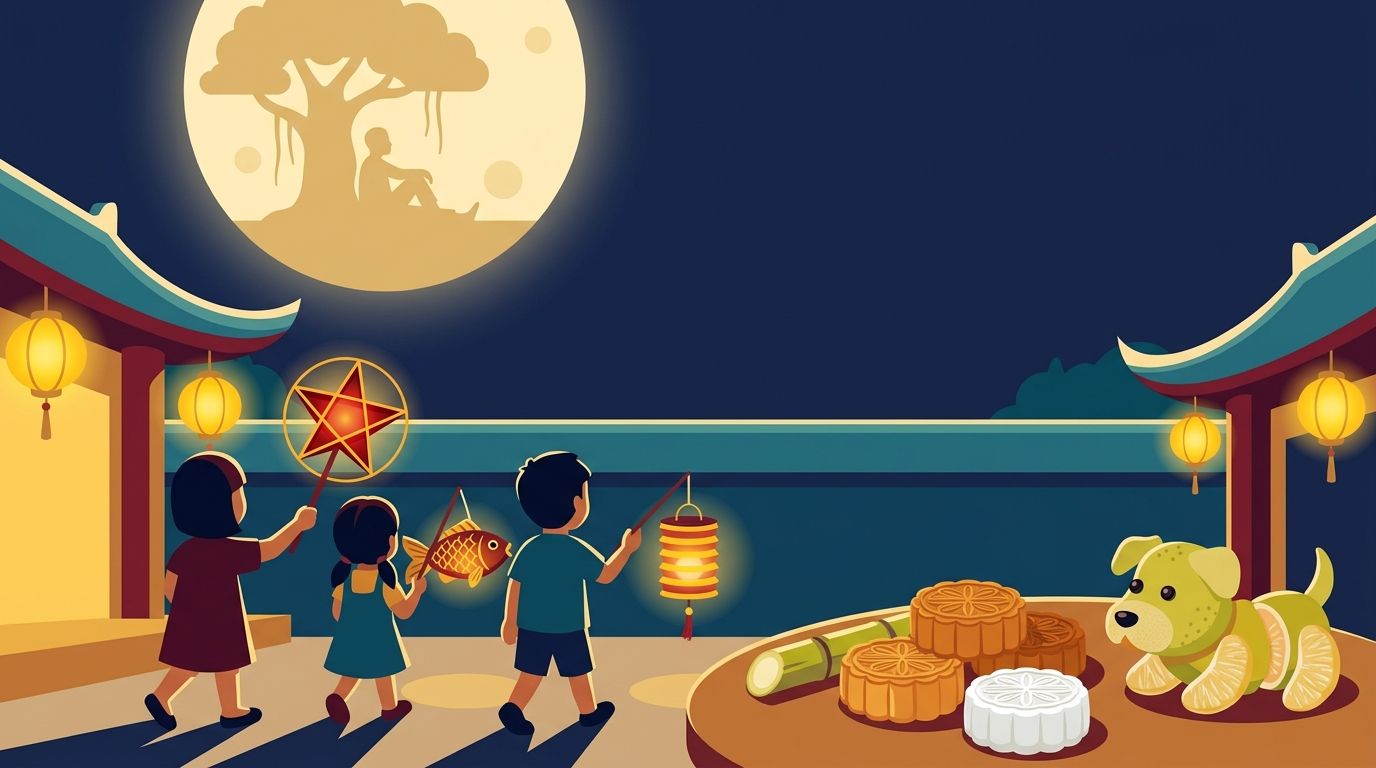
- One full moon, three different holidays. Chinese families mark a reunion; Korean families mark Chuseok, a harvest thanksgiving for the ancestors. Vietnamese families gave the night to the children: Tết Thiếu Nhi, the children's festival, or Tết Trông Trăng, the moon-watching festival.
- Three things make a Vietnamese Trung Thu: Uncle Cuội sitting under his banyan tree on the moon, the star lantern and the song "Rước đèn tháng Tám," and the family tray with baked and soft mooncakes and a dog made of pomelo.
- In Little Saigon this week: Điều Ngự Temple hands out free lanterns on Saturday, September 19. Westminster holds its first Moon Lantern Celebration on Saturday, September 26. The lion dancers are local high school students.
The short of it
Tết Trung Thu — literally "mid-autumn festival" — falls on the 15th day of the eighth lunar month, the night the moon is roundest. This year that is Friday, September 25, 2026. Across East and Southeast Asia the same moon means a holiday: Chinese families gather for the Mid-Autumn Festival, Korean families for Chuseok. Vietnamese families have their own version, and it is aimed squarely at children.
In Little Saigon that means a temple handing out lanterns on Chestnut Street, a lantern night at the Westminster Civic Center, and lion-dance troupes of teenagers working two weekends straight. Bolsa Bridge's guide "Trung Thu ở Bolsa 2026" has every date, time and address. If you grew up here saying "Moon Festival" and eating a mooncake without asking questions, this one's for you — five things, in the order a grandparent would tell them.
1. It is the same full moon — but not the same party
The date is shared. The meaning is not.
In China, the Mid-Autumn Festival is a reunion holiday: family comes home, everyone eats mooncakes and looks at the moon, and the story told is about Chang'e, the woman who drank an elixir and floated up to live there. In Korea, Chuseok is a harvest thanksgiving: families visit ancestors' graves, perform memorial rites and eat songpyeon, half-moon rice cakes. Both are for the grown-ups, with children along for the ride.
Vietnam took the same harvest moon and gave it to the kids. The festival began as a celebration of the rice harvest — many Vietnamese live in rural areas and work as farmers, as the national tourism authority puts it — and the full moon marked the moment the fields were in and parents finally had time. Over the generations it became what Vietnamese call Tết Thiếu Nhi, the children's festival, or Tết Trông Trăng, the moon-watching festival. Adults buy the lanterns and bake the cakes. The evening belongs to the children.
That is why, if you walk into Điều Ngự Temple on September 19, you will find contests for drawing and lantern-decorating and free toys for every kid, and not much for you. That is the point.
2. The man in the moon is a woodcutter named Cuội
Ask a Vietnamese grandmother who lives on the moon and you will not hear about a rabbit or a goddess first. You will hear about Chú Cuội — Uncle Cuội.
Cuội was a woodcutter who came upon a magic banyan tree (cây đa) whose leaves could bring the dead back to life. The tree came with one rule: never water it with anything unclean. One day, the story goes, his wife forgot, and the banyan tore itself out of the ground and rose into the sky. Cuội grabbed its roots to hold it down and was carried up with it, all the way to the moon. On a clear Mid-Autumn night, Vietnamese say you can see him there — the dark shape of a man sitting under a tree.
Here is the part that changes how you look at a lantern parade. In one popular telling, repeated every year in Vietnamese-language guides for parents, the children carry their lights to help light Cuội's way back home. Tell it that way and the rước đèn — the lantern procession — is not just decoration. It is a search party.
(The Chinese stories are told in Vietnamese homes too — Hằng Nga, the moon goddess, and Thỏ Ngọc, the jade rabbit — but Cuội is the one that is ours.)
3. The lanterns are the whole point — and there is a song
Three lanterns you will see at any Trung Thu in Little Saigon, and what to call them:
Đèn ông sao — the star lantern. Five points, bamboo frame, red cellophane, sometimes fringed with tinsel. The tourism authority calls it the most popular Trung Thu lantern. The one everybody's parents remember.
Đèn kéo quân — the "marching soldiers" lantern. A tall paper cylinder with a candle inside; the heat spins a paper carousel so that shadows of soldiers, horses and farmers parade around the outside. The hardest to make, the most fun to watch.
Đèn cá chép — the carp lantern, a fish that in the old stories works hard enough to turn into a dragon.
In Vietnam, whole streets sell them in the weeks before — Hàng Mã Street in Hà Nội is the famous one. In Little Saigon you will find them in the gift shops at Phước Lộc Thọ (the Asian Garden Mall) and given away free at temple festivals.
And when the children walk, they sing. The song is "Rước đèn tháng Tám" — "Lantern Parade in the Eighth Month" — by the composer Đức Quỳnh, born Nguyễn Đức Quỳnh (1922–1994). He first signed it with the pen name Vân Thanh and later changed the credit because he kept being confused with another composer with a near-identical name, according to Kenh14. Its first line is the one every Vietnamese kid of the last seventy years knows: "Tết Trung Thu rước đèn đi chơi…" — "At Mid-Autumn we carry lanterns out to play." Play it in the car on the way to the temple; watch what your parents do.
4. Two kinds of mooncake, and a tray that matters as much as the cake
You know the mooncake. You may not know there are two.
Bánh nướng — the baked one. Golden wheat crust pressed in a wooden mold with flowers, carp or geometric patterns; inside, either thập cẩm ("mixed"), a dense filling of roasted seeds and nuts, candied winter melon and often a salted egg yolk, or a sweet đậu xanh (mung bean) paste.
Bánh dẻo — the soft one. A white, chewy, mochi-like skin made from cooked glutinous rice flour, eaten unbaked and cool. Your generation calls it snow-skin.
Both go on the mâm cỗ, the family tray set out under the moon: the cakes, a pomelo (bưởi), sticks of sugar cane, seasonal fruit — and, in the classic northern tray, a chó bưởi, a shaggy little dog built from separated pomelo segments with two black beans for eyes, sitting in the middle. It is traditionally arranged for the children to admire first and raid later.
If you are the one buying this year: the bakeries along Westminster Boulevard and Bolsa Avenue have been making both kinds for decades.
5. The lion is a lân — and the kids run the show
The drumbeat you hear before you see anything is múa lân, the lion dance, which the tourism authority calls an essential part of the festival. Two things a grandparent would correct you on. First, the creature is a lân, from kỳ lân, the mythical qilin of East Asian lore — which is why the Vietnamese name is not the word for "lion." Second, the pairing itself is Vietnamese: as Wikipedia notes, Chinese communities often stage dragon dances for this festival, while the Vietnamese do lion dances, and the 14th and 15th nights of the lunar month are the troupes' busiest of the year.
The rest of the evening is a children's world too. Tiến sĩ giấy — paper "doctors of letters," little effigies of a scholar in a mandarin's robe — are set on the tray so the kids will study hard. Tò he, tiny figurines of animals and heroes molded from colored rice dough, are the traditional street toy. And hát trống quân, drum-and-answer singing between two groups to a "thình thùng thình" beat, is the old soundtrack of the moon-watching night in the north.
In Little Saigon the neighborhood troupe became something else. Thiên Ân Performing Arts, a Westminster nonprofit founded in 2005, teaches lion dance and traditional drumming to local teenagers, many of them from Westminster High's Vietnamese American Culture Club. On January 1, 2025, the club's lion dance team rode with the "Journey of Dreams" float in the Rose Parade, according to the OCDE Newsroom. Thiên Ân's own site lists Mid-Autumn festivals right next to Lunar New Year among the events it performs.
Where to see it in Little Saigon this year
Saturday, September 19, 3–8 PM — Vui Tết Trung Thu at Chùa Điều Ngự, 14452 Chestnut St., Westminster: free lanterns, mooncakes and toys for every child; lion dance, contests.
Monday, September 21 and Wednesday, September 23 — the Westminster Senior Center holds a morning Moon Festival on Monday; the Westminster Library hosts a Mid-Autumn afternoon on Wednesday.
Friday, September 25 — the full moon itself. Westminster's Fall Festival opens at the Civic Center with a welcome ceremony at 8 PM and the city's first drone show at 8:30 PM.
Saturday, September 26, 5–9 PM — Westminster's new Moon Lantern Celebration at the Civic Center, 8200 Westminster Blvd. Presented with Little Saigon TV, per the city's press release.
Phước Lộc Thọ's lantern night ran on Saturday, September 27 last year; the mall had not posted a 2026 date when this story went to press. Full details, times and what's free: Bolsa Bridge's guide "Trung Thu ở Bolsa 2026."
Why it's built to be handed down
Two public schools in this neighborhood now teach in two languages. DeMille Mỹ Việt Language Academy in the Westminster School District opened in 2015 as the first Vietnamese dual-immersion program in California, according to the district. Murdy Elementary in Garden Grove Unified opened its Vietnamese dual-immersion strand in 2018. Their students will learn the Cuội story in both.
Every Trung Thu tradition — the lantern for Cuội, the tray set out for the children, the amateur lion team — was designed by adults to be given away to a child. That is what makes it the easiest Vietnamese holiday for a second generation to inherit. You do not need to know the whole story to carry a lantern on September 25. You just need to know whose way you are lighting.
Tết Trung Thu → Mid-Autumn Festival
Chúc Tết Trung Thu vui vẻ! (Happy Mid-Autumn Festival!)
rước đèn → lantern parade
Tối nay các cháu đi rước đèn ở chùa. (Tonight the kids join the lantern parade at the temple.)
đèn ông sao → star lantern
Ba làm cho con một cái đèn ông sao. (Dad made me a star lantern.)
múa lân → lion dance
Đội múa lân toàn học sinh trung học. (The lion dance troupe is all high school students.)
bánh nướng / bánh dẻo → baked mooncake / soft mooncake
Con thích bánh dẻo hơn bánh nướng. (I like the soft mooncake more than the baked one.)
mâm cỗ → festive tray
Bà bày mâm cỗ cho các cháu phá. (Grandma sets out the tray for the kids to raid.)
chú Cuội → Uncle Cuội (the man in the moon)
Nhìn lên trăng, con thấy chú Cuội không? (Look at the moon, can you see Uncle Cuội?)
trông trăng → to watch the moon
Cả nhà ngồi trông trăng ngoài sân. (The whole family sits watching the moon in the yard.)
🧩 Play Cầu Chữ — the daily word game from Bolsa Bridge, built from vocabulary boxes like this one →
Sources & verification notes · 10 sources
- Vietnam National Authority of Tourism, "Vietnam's magical Mid-autumn Festival" — source for the harvest origin, the "Children's Festival" name, the red-cellophane star lantern, the two mooncake types, lion dance as "an essential element," and a short Cuội summary. https://vietnam.travel/things-to-do/vietnams-magical-mid-autumn-festival
- Wikipedia, "Tết Trung Thu" (English and Vietnamese editions) — the names Tết Trông Trăng / Tết Thiếu Nhi, the 2026 date, kéo quân lanterns, tiến sĩ giấy, tò he, trống quân singing, the pomelo dog on the tray, dragon dance (Chinese) vs. lion dance (Vietnamese), and the 14th–15th nights as the busiest. https://en.wikipedia.org/wiki/T%E1%BA%BFt_Trung_Thu · https://vi.wikipedia.org/wiki/T%E1%BA%BFt_Trung_thu
- Wikipedia, "Mid-Autumn Festival" and "Chuseok" — for the Chinese reunion festival and Chang'e, and for Chuseok's harvest rites, grave visits and songpyeon. https://en.wikipedia.org/wiki/Mid-Autumn_Festival · https://en.wikipedia.org/wiki/Chuseok
- Wikipedia, "Lion dance," Vietnam section — "lân" derives from "kỳ lân" (qilin); múa lân as the general southern term. https://en.wikipedia.org/wiki/Lion_dance
- Kenh14, September 21, 2021 (Vietnamese) — composer Nguyễn Đức Quỳnh (1922–1994), pen name Vân Thanh on the song, later credited as Đức Quỳnh to avoid confusion with composer Văn Thanh; Trẻ Magazine (Vietnamese) gives the same attribution. https://kenh14.vn/thuong-thay-tac-gia-ca-khuc-ruoc-den-thang-tam-nhac-ai-cung-thuoc-nhung-ten-nguoi-sang-tac-lai-rau-ong-no-cam-cam-ba-kia-20210918191659632.chn · https://baotreonline.com/van-hoc/tap-ghi/tet-trung-thu-ruoc-den-di-choi.baotre
- The folk tale "Sự tích chú Cuội cung trăng" as commonly told (Vietnamese) — the life-restoring banyan, the rule about unclean water, the wife's lapse, the tree carrying Cuội to the moon. A folk tale with many variants. https://truyencotich.vn/truyen-co-tich/co-tich-viet-nam/su-tich-chu-cuoi-cung-trang.html
- "Ý nghĩa đằng sau sự tích rước đèn Trung Thu," a Vietnamese-language parenting guide — cited only as an example of one popular retelling (lanterns lighting Cuội's way), not as a historical source; the story labels it "one popular telling." https://www.mykingdom.com.vn/blogs/vong-quanh-the-gioi/y-nghia-dang-sau-su-tich-ruoc-den-trung-thu
- Thiên Ân Performing Arts (official site) · Spectrum News 1, February 4, 2019 · OCDE Newsroom, January 2025 — founded 2005, Westminster nonprofit, teaches lion dance and drumming, performs at Lunar New Year and Mid-Autumn events; Westminster High's Vietnamese American Culture Club lion dancers joined the "Journey of Dreams" float (Love2Yêu) on January 1, 2025, with Thiên Ân. https://www.thienanperformingarts.com/ · https://spectrumnews1.com/ca/la-west/news/2019/02/04/thien-an-performing-arts-group-inspires-younger-generations-to-embrace-vietnamese-culture- · https://newsroom.ocde.us/weekly-roundup-westminster-high-school-students-celebrate-vietnamese-culture-at-rose-parade-orange-county-monitors-winds-and-fire-risks-and-more/
- Westminster School District, "A Decade of Bilingual Excellence at DeMille" · GGUSD, Murdy Elementary Vietnamese Dual Immersion — DeMille marked ten years on May 16, 2025, "first of its kind in California" per the district; Murdy opened its Vietnamese dual-immersion strand in 2018–19, TK through grade 6. https://www.wsdk8.us/about-us/district-news/a-decade-of-bilingual-excellence-at-demille · https://www.ggusd.us/programs/dual/murdy-elementary-vietnamese-dual-immersion
- Bolsa Bridge, "Trung Thu ở Bolsa 2026" (published September 14, 2026, last updated September 24) — all 2026 event dates and times come from the guide (original sources: Điều Ngự Temple's announcement, Westminster's Fall Festival page, OC Public Libraries' calendar, Phước Lộc Thọ's site). A second update is planned for September 24. https://bolsabridge.com/bai/trung-thu-o-bolsa-2026
- Food & EventsTết Trung Thu falls on Friday, Sept. 25 this year: here's where your family can celebrate around Bolsa — most of it free
- Food & EventsBuying mooncakes in Bolsa this year: three neighborhood bakeries in Westminster — and why the box your relatives bring from Vietnam can get held at the airport
- Food & EventsYour weekend beyond the lanterns: a color run, a casino night for the K9s, and a free car-seat check