Housing & Planning
Westminster's Aug. 19 planning night: a claw-machine arcade wins approval on Bolsa, the 74-unit project loses its appeal 5–0 — and the density fight in your neighborhood now rests with a judge
In 75 minutes on the evening of August 19, 2026, Westminster's Planning Commission settled two matters. A Vietnamese American family got the permit to open a claw-machine arcade right on Bolsa Avenue. And the developer of the 74-unit project at 6351 Westminster Blvd saw its appeal denied in full. The first story is over. The second has only moved to Orange County Superior Court, where a judge will decide whether a city can raise its minimum building density while an application is already in the pipeline. That answer will reach far beyond one parking lot off the 405.
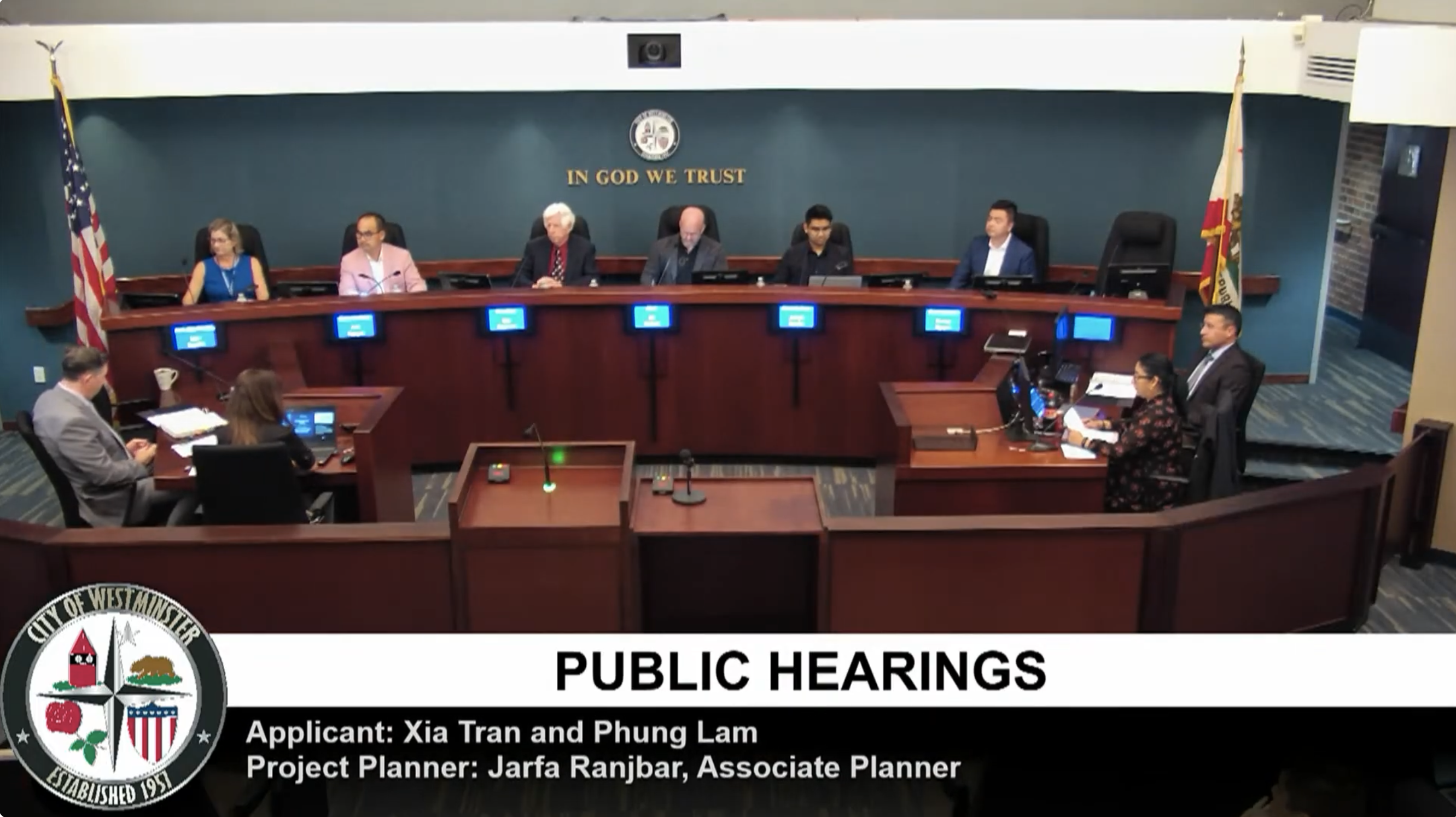

- The claw arcade at 9631–9633 Bolsa Ave was approved 5–0. It will have 20 claw machines and 24 prize vending machines, open 11 a.m. to 10 p.m. daily. The Tran family already runs four arcades in Texas.
- The 74-unit project at 6351 Westminster Blvd: the commission denied the developer's appeal 5–0 and upheld the city's position. The city admitted one small error, about an expiration date on a letter. The other five points stood.
- It isn't over. The lawsuit in Orange County Superior Court continues. The developer had 15 days to appeal to the City Council. Its representative said that if the city wins in court, the company will come back with a rental project of at least 200 units, four to five stories tall.
What happened on August 19
The Westminster Planning Commission met at 6 p.m. on Wednesday, August 19, 2026, in the City Council Chambers at 8200 Westminster Blvd. The five-member commission is appointed by the City Council. It rules on land-use permits, development projects and planning appeals, and its decisions can be appealed to the council.
All five commissioners were present: Chair KC Wolbert, Vice Chair Don Anderson, and Commissioners Anh "Andy" Nguyen, Joseph Nguyen and Tommy Nguyen. The meeting had two public hearings and adjourned at 7:15 p.m., according to the chair on the city's audio recording.
Before the hearings, two commissioners made a disclosure worth noting. About a month before the meeting, each had received a text message from the developer of the 74-unit project with a Dropbox link to the appeal materials. Both said they opened the link but had "no substantive discussion" with the developer about the merits, and that the same materials are now in the public agenda packet. The commission's agenda sets aside a slot for these disclosures, called ex parte communications: contacts outside the hearing about a matter awaiting a decision. The recording does not identify the two commissioners. The official minutes had not been posted when this story went to press.
The claw arcade on Bolsa: 5 votes yes (Item 8.1)
The first hearing was Case No. 2026-0036. Xia Tran and Phung Lam applied for a conditional use permit, a permit the city can grant with conditions attached, to open an indoor entertainment facility with claw machines at 9631 and 9633 Bolsa Avenue.
Associate Planner Jarfa Ranjbar presented the case. Two vacant suites will be combined into one 2,523-square-foot space with 20 claw machines, 24 vending machines, storage, a display area and restrooms. Proposed hours are 11 a.m. to 10 p.m. daily. The shopping center sits on 5.9 acres, bordering Garden Grove to the north and west; the land is zoned mixed use, and the general plan labels it "Mixed Use Little Saigon." No new parking is required because the center already meets the city's parking standard. Staff recommended approval.
A family friend who gave her name as Annie Lin spoke for the applicants. With her was Annie Tran, who will run the arcade day to day. The whole family was in the room.
The family operates four arcades in Texas under the name Claw Mania Kingdom, the representative said. The chain's website lists exactly four locations: two on Bellaire Boulevard in Houston, one in Carrollton and one in Haltom City. Annie Tran designed the logo and graphics and runs the Instagram account and all of the marketing, the representative said. In January 2025, KPRC 2, Houston's NBC station, featured the arcade on its Houston Life program, with Tran appearing as the chain's social media and events manager. The family is expanding to California because of deep roots here, the representative said: the parents grew up in Northern California, and aunts live in Corona and Anaheim.
The commissioners' questions were the everyday kind. Are the machines noisy? When a customer wins, "it makes a little winning sound, and it says, you win," the representative said, soft enough that only the player hears it. What do the vending machines sell? Prizes only, for children too young for the claw machines, "because it is a skills game." Commissioner Andy Nguyen asked about food. None, and no drinks: "there's plenty of restaurants in the plaza." The long counter down the middle of the space will be a staffed welcome desk, so employees can keep an eye on the whole room.
One commissioner asked why Westminster. The location is "right in the heart of" the plaza, the representative said, drawing customers of every age and background, a place for families and friends "to make memories." Asked what success would look like a year after opening, she listed free giveaways at Lunar New Year and the Mid-Autumn Festival, projects with schools, and inviting small vendors to sell trinkets and stickers inside the arcade without charging them a fee.
No residents signed up to speak. Vice Chair Anderson moved to approve as recommended, and Chair Wolbert seconded. The roll call: Andy Nguyen, Joseph Nguyen, Tommy Nguyen, Anderson and Wolbert, all yes. Resolution No. 26-007 passed 5–0. The decision takes effect 15 days after the date on the notice of decision, and it can be appealed to the City Council during those 15 days.
The 74-unit project: appeal denied, but "we are not discussing whether this project should be approved or denied" (Item 8.2)
The second hearing ran close to an hour. It picks up the story Bolsa Bridge told on August 18. Andrew Fielder's company, 6351 Westminster Blvd, LLC (Back Bay Investment Group, Newport Beach), wants to build 68 for-sale townhomes plus six junior accessory dwelling units, or JADUs, small secondary units inside the main homes. The site is the former Big Lots at 6351 Westminster Blvd, catty-corner from the In-N-Out at Westminster Boulevard and the 405. The developer wants to count the six JADUs as affordable units to qualify for benefits under California's density bonus law. The city says it cannot. The developer appealed the Community Development Director's determination, and it has also sued the city in Orange County Superior Court.
The city's case: six points of appeal, one conceded
Principal Planner Ken Fichtelman presented for the city and walked through the timeline. On August 20, 2025, this same Planning Commission voted 5–0 to recommend that the City Council reject an ordinance raising the minimum density on housing overlay sites from 20 to 30 units per acre. The council adopted the urgency version, effective immediately, on September 10, 2025, and the regular version on September 24, 2025. The city's municipal code records them as Ordinance 2625U and Ordinance 2626. The developer filed its application on October 21, 2025. After three rounds of "conformity" review and an appeal filed April 29, 2026, the city was served with the lawsuit on May 29, 2026. A fourth conformity letter went out July 16, 2026.
Fichtelman then took the six points of the appeal one by one.
One, that the urgency ordinance is invalid. The commission cannot rule on a law already on the books, he said: "Once something is made law, the only two bodies that can change that law are the city council by repealing it or a court through a ruling." The city rejects the "spot zoning" charge because the ordinance applies to every property in the housing overlay, not just this one. It also rejects the claim that the state Department of Housing and Community Development (HCD) had to approve the ordinance first, because the ordinance did not prohibit development and therefore was not a moratorium.
Two, whether JADUs are allowed in this project at all. The city treats 68 attached townhomes in eight buildings as a multifamily development under the Government Code definition, which means the JADU law written for single-family homes does not apply. The developer says each townhome sits on its own lot and is therefore a single-family home.
Three, whether JADUs can count as affordable units. The city "has no teeth to force those homeowners to rent these properties," Fichtelman said, so it cannot guarantee the long-term affordability that density bonus law requires. HCD has advised the city, by email and in a Zoom meeting, against using deed-restricted secondary units to qualify for a density bonus when the primary units are for sale, he said.
Four, the required plan revisions follow from points two and three.
Five, a wrong expiration date. The city conceded this one: a planner used an old letter template. The city has already told the developer in writing that the application remains active, so there was nothing for the commission to rule on, he said.
Six, that all of the above adds up to a disguised denial. The city says the application was deemed complete within the legal deadline and that each conformity letter simply listed deficiencies for the developer to fix.
Why raise the minimum density when it did? Fichtelman said that from late 2024 into 2025, at least four owners of housing overlay sites asked about building at roughly 22 units per acre. Allowing all of them would have cost the city 100 to 150 units against its state housing target, forcing it to reopen its housing element and invite fresh scrutiny from HCD. "We did not want HCD to have another crack at our housing element," he said. The city has not banned lower-density housing, he added: the R5 zone still allows 19 to 25 units per acre, and a 23-unit-per-acre townhome project came in two months ago.
Commissioner Tommy Nguyen asked to pin down the scope: "We are not discussing whether this 74-unit housing project should be ultimately approved or denied, but looking at the appeal of the director's conformity determination, correct?" Correct, Fichtelman said. Commissioner Joseph Nguyen worried about precedent: if each townhome counts as a single-family home, what stops every future project from tacking on secondary units? Under the developer's reading, Fichtelman answered, every lot would qualify for both an ADU and a JADU: "That means you could have 68 garage conversions on this property." And the same reading would apply retroactively to attached townhomes already built.
The developer's side: 12 minutes, and no extension
Eric Higuchi, the owner's representative, used the full 12 minutes the rules allow. He opened with the question he wanted the commissioners to keep in mind, "what makes sense for our community?", then answered the city's analysis point by point. Above roughly 20 units per acre, "for-sale housing simply doesn't pencil," he said, while rental projects need at least 35 units per acre to work. Raising the minimum density, in his view, pushes land toward rentals, with more people and more traffic. He cited a City of Tustin analysis of a hypothetical 10-acre site: for-sale townhomes net the general fund about $128,000 a year, while market-rate rental apartments net a loss. He turned the city's argument around: how has the city ever guaranteed that any landlord leases a unit? And can a city deny a housing project because it doubts the developer can sell or rent? He also quoted an HCD response that every parcel with a single-family dwelling, "even an attached single-family dwelling, such as half-plexes and townhomes," may add one ADU or one JADU.
Higuchi closed with two scenarios. If the case goes to court and the developer wins, the project proceeds, "albeit significantly delayed," and the city pays both sides' attorney fees and possibly an HCD penalty. If the city wins, "we come back with a for-rent project that's at least 200 units with a four to five-story building," possibly 100 percent affordable. With a density bonus, he said, that could reach 400 units. "I don't want to sound like that threatening lawyer," he said. "These are a lot of the realities we face at the state law level."
With a minute left, he asked for more time. "I'm not inclined to grant an extension," Chair Wolbert said, and no commissioner spoke up. That left the developer's land-use attorney, Edward "EJ" Schloss of Cox, Castle & Nicholson, to make the legal argument in the three minutes allotted to an ordinary speaker. Nothing in the density bonus law, Government Code section 65915, requires a developer to guarantee that a secondary unit will be rented, he said. Section 66323 allows one ADU and one JADU "on a lot with a proposed or existing single-family dwelling." And HCD's own ADU handbook defines a single-family dwelling to include a unit existing as a separate interest in real property, "such as a detached single-family dwelling or a townhouse."
Andrew Fielder, the property owner and developer, reminded Wolbert and Anderson that both had voted on August 20, 2025, to recommend denying the density ordinance, after the commission found the amendment "would be detrimental to the public interest." He said the ordinance was designed to "preemptively attack" his project and accused the city of "willful misinterpretations" of state law. He then laid out consequences under the Housing Accountability Act: a court can order a city to approve a project if it finds bad faith, the city would owe attorney fees, and penalties can reach $50,000 per violation. Continued delay, he said, might amount to a temporary taking requiring compensation. "My goal isn't to frame this as a threat," he said, "but rather to just level set on what the city might be looking at."
Wolbert waived the applicant's rebuttal, since the two speakers after Higuchi were part of the applicant's team, and closed the hearing. Fichtelman asked to respond to one point: the definition of "single-family residence" the attorney cited, section 54236, begins "as used in this article" and applies only to the article on surplus residential property, not to planning law.
The vote
One commissioner said the commission's 2025 recommendation against the ordinance is "done and over with"; the council approved what the commission had opposed, and that has no bearing on tonight's question. Fichtelman added that the commission was a recommending body then, the council was free to overrule it, and once the ordinance took effect, it became law the commission has no power to void.
Chair Wolbert spoke and then moved. "I personally feel that City staff and community development got this correct in their minds," he said. "They've worked with our city attorneys to figure out the best course of action for this type of situation. I think they got it right. That's my opinion." He moved to adopt the resolution denying the appeal and affirming the director's determination. When he misspoke and said "approve case number 2025-0228," a staff voice cut in: "Don't approve the case, Casey," adopt the resolution attached to it, No. 26-008. "I'll second that motion," two commissioners said at once. "Joseph beats you to the punch, Don, but thank you," Wolbert replied. The clerk recorded a motion by Chair Wolbert, seconded by Commissioner Joseph Nguyen, and read the resolution's full title into the record.
The roll call: Andy Nguyen, yes; Joseph Nguyen, after confirming that "a yes is to affirm the director's decision," yes; Tommy Nguyen, yes; Anderson, yes; Wolbert, yes. Resolution 26-008 passed 5–0, denying the appeal and affirming the Community Development Director's conformity determination. The clerk announced only "motion carries" without reading a count; the 5–0 tally is from the audio recording, and the official minutes had not been posted when this story went to press.
The decision took effect 15 days after the date on the notice of decision. During those 15 days, the developer could appeal in writing to the City Council through the City Clerk.
What comes next
Three threads to follow:
An appeal to the City Council. The 15-day window closed in early September. The council's September 9, 2026 agenda had no item on 6351 Westminster Blvd. The agenda for September 23 had not been posted when this story went to press. The city's public records so far show no appeal.
The lawsuit. 6351 Westminster Blvd, LLC v. City of Westminster and the City Council, Orange County Superior Court Case No. 30-2026-01573344-CU-WM-CXC, was filed May 28, 2026. It is assigned to Judge Melissa R. McCormick at the Civil Complex Center, 751 West Santa Ana Boulevard, Santa Ana. According to Fichtelman, the suit challenges the two density ordinances. No hearing date appears in the city's public file.
A new zoning code. On September 2, 2026, the commission heard a first briefing on the Phase 2 Zoning Update, a rewrite of the city's zoning code. Staff said they were not yet presenting code language, only direction. This is where the questions about density, secondary units and townhomes will be written into law for every residential neighborhood in the city.
Want to follow along? The Planning Commission meets the first and third Wednesdays of each month at 6 p.m. in the Council Chambers, 8200 Westminster Blvd. The September 16 meeting had a single hearing, on temporary signage for Target at Westminster Mall. The next regular meeting on the calendar is Wednesday, October 7, 2026. Watch live on the city's WTV channel (Spectrum 3, Frontier FiOS 42) or the city's streaming page. Agendas and minutes are posted on the Planning Commission's Agendas & Minutes page. Audio and video land in the city's Granicus archive, usually a few weeks late.
Planning files:
Planning Division (714) 548-3247
Appeals to the City Council:
City Clerk (714) 548-3237
kháng cáo → appeal
Chủ đầu tư kháng cáo lên Hội đồng Thành phố. (The developer appealed to the City Council.)
máy gắp thú → claw machine
Tiệm có 20 máy gắp thú. (The arcade has 20 claw machines.)
điều trần công khai → public hearing
Phiên họp có hai mục điều trần công khai. (The meeting had two public hearings.)
ủy viên → commissioner
Năm ủy viên đều bỏ phiếu thuận. (All five commissioners voted yes.)
giữ nguyên → to uphold / to affirm
Ủy ban giữ nguyên quyết định của thành phố. (The commission upheld the city's decision.)
vụ kiện → lawsuit
Vụ kiện vẫn đang chạy ở tòa. (The lawsuit is still moving through the court.)
để bán / cho thuê → for sale / for rent
Nhà để bán hay nhà cho thuê? (For sale, or for rent?)
mật độ → density
Mật độ càng cao, càng nhiều căn trên một mẫu đất. (The higher the density, the more units on one acre of land.)
🧩 Play Cầu Chữ — the daily word game from Bolsa Bridge, built from vocabulary boxes like this one →
Sources & verification notes · 10 sources
- Audio recording of the Westminster Planning Commission meeting, August 19, 2026, from the city's Granicus archive (1 hr 29 min; the first 10 minutes are pre-meeting silence). Primary source for the proceedings, remarks and votes; quotations are verbatim. The 5–0 tally on Item 8.2 is from the recording: the clerk announced only "motion carries"; there is a moment of crosstalk on Commissioner Andy Nguyen's vote, and on a September 18, 2026 re-listen his answer is "Yes." "Annie Lin" is spelled as heard. Fichtelman read the ordinance numbers in the opposite order from the municipal code; this story follows the code. MP3: https://archive-video.granicus.com/westminsterca/westminsterca_a7c7deb0-c727-4d8b-a324-929182883fba.mp3 — index: https://westminsterca.granicus.com/ViewPublisher.php?view_id=6
- Westminster Planning Commission agenda, August 19, 2026, Item 8.1 (Case No. 2026-0036, Resolution No. 26-007) and Item 8.2 (Case No. 2025-0228): applicant names, project planners, resolution numbers, addresses and project descriptions. https://www.westminster-ca.gov/home/showpublisheddocument/11178
- Staff report for Item 8.2 (10 pages) and draft Resolution 26-008 — the city's position going into the hearing; other case documents are listed in the August 18 story. https://www.westminster-ca.gov/home/showdocument?id=11152 · https://www.westminster-ca.gov/home/showdocument?id=11154
- Summons, 6351 Westminster Blvd, LLC v. City of Westminster, Orange County Superior Court Case No. 30-2026-01573344-CU-WM-CXC, e-filed May 28, 2026 — scanned copy in the meeting packet. Case number, court, judge, parties and counsel are from page 1; the file is a non-searchable scan, so what the suit challenges is per Fichtelman on the recording; no hearing date appears in the file. https://www.westminster-ca.gov/home/showdocument?id=11158
- Westminster Municipal Code, Chapter 17.250 Overlay Zones (eCode360) — history note "Ord. 2625U, 9/10/2025; Ord. 2626, 9/24/2025": source for the numbers and adoption dates of the two density ordinances. https://ecode360.com/43534803
- Westminster City Council agenda, September 9, 2026 (Granicus) — checked: no item on 6351 Westminster Blvd. The September 23 agenda was not yet posted on Granicus as of the morning of September 18, 2026. https://westminsterca.granicus.com/AgendaViewer.php?view_id=2&clip_id=878
- City of Westminster, Planning Commission page — members, meeting schedule, WTV channels; and the Agendas & Minutes page. Checked September 18, 2026: the 2026 minutes folder ends with the May 20 meeting; the August 19 minutes are not posted. https://www.westminster-ca.gov/departments/community-development/planning-division/planning-commission · https://www.westminster-ca.gov/departments/community-development/planning-division/planning-commission/agendas-minutes
- Claw Mania Kingdom — the chain's contact page (four Texas locations) and KPRC 2 Houston Life, January 13, 2025, "Go for the grab! Inside Claw Mania Kingdom": confirms the Texas locations and Annie Tran's role. Family details (parents' hometown, relatives) are the representative's account on the recording, not independently verified. https://www.clawmaniakingdom.com/contact · https://www.click2houston.com/houston-life/2025/01/13/go-for-the-grab-inside-claw-mania-kingdom-houstons-first-claw-machine-arcade/
- California Government Code sections 65915 (density bonus), 66323 (ADU/JADU) and 54236 — statutes cited by both sides at the hearing. This story reports each side's argument and does not judge which is correct. https://leginfo.legislature.ca.gov/faces/codes_displaySection.xhtml?lawCode=GOV§ionNum=65915 · https://leginfo.legislature.ca.gov/faces/codes_displaySection.xhtml?lawCode=GOV§ionNum=66323 · https://leginfo.legislature.ca.gov/faces/codes_displaySection.xhtml?lawCode=GOV§ionNum=54236
- Bolsa Bridge, August 18, 2026, "74-unit project sues the city" — pre-hearing background; updated with the vote result on September 12, 2026. https://bolsabridge.com/bai/du-an-74-can-6351-westminster
- Housing & PlanningA 74-home project is suing Westminster: if it wins, your neighborhood could be next
- Local GovernmentOrange County wants the $1 million arch money back: the Little Saigon gateway you've waited 30 years for is on the line again
- Local GovernmentA city building on Beach Blvd. and the Vietnamese Library: Westminster goes behind closed doors Wednesday